Note · Local models · 7 min read
For many tasks you don't need the best model at all
Three computers at home, one open language model running locally and a fair amount of automation running on it. Why, for many business tasks, a smaller model is more than enough.
There is one thing I tell almost everyone who asks me about artificial intelligence in their business: for a great many tasks you don't need the best or the biggest model on the market at all. Big tech companies release a new (usually even more powerful) model every so often, and almost every time they try to convince you that this is the model you need, the one you won't be able to manage without. I think that in many cases this is not true. Let me try to explain why.
Why the biggest models run in the cloud
Let's start with what such top models need in order to run at all. With the biggest models there is so much data that you need many specialized compute cards, plus servers that tie them together into a single system, cooling, because such hardware gives off huge amounts of heat, a power supply bigger than an ordinary office usually has, and people to keep it all running. Setting up something like that yourself is possible in theory, but given the real costs, the size of the room needed and the power supply it takes, it is very unlikely. That is why such models run in large data centers, and you use them over the internet, paying the provider for each request. And I could stop there, except that I don't consider this a problem at all.
What companies actually want to automate
When you look at what many companies actually want to automate, in many cases it turns out that these are not tasks that need the most powerful models. Reading the data off an invoice and entering it into a system, sorting customer messages by what they are about, summarizing a long document, checking whether a request is complete, rewriting meeting notes into a proper report: these are simple, repetitive tasks, and in my experience smaller models can handle them quite decently. Smaller models are much cheaper to run, and with that, they can be run on hardware that is far more affordable and within reach of many companies, and even individuals. For example, on a computer that sits in the office or (as in my case) at home.
My hardware for a local language model
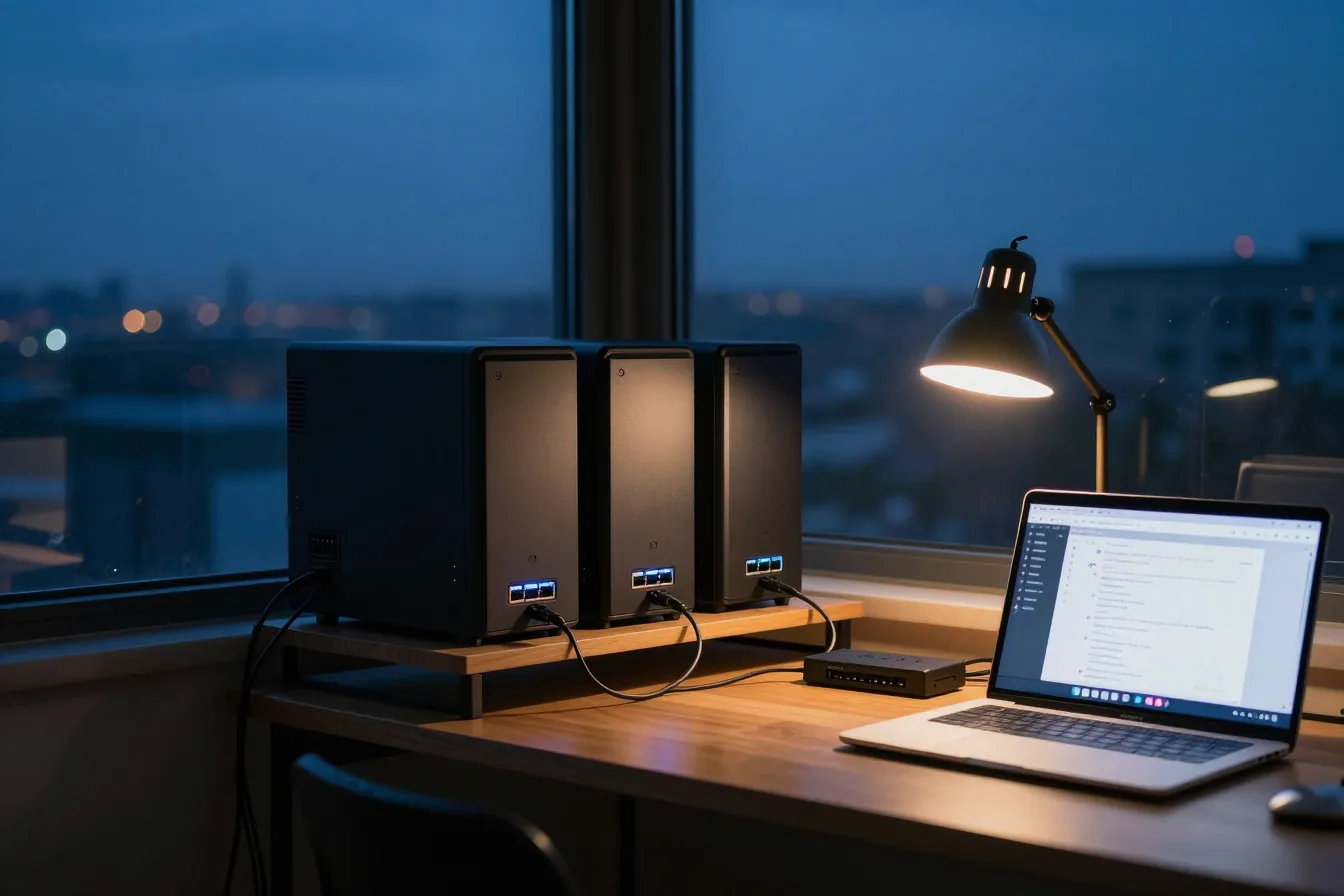
This is how it looks for me. I have three computers that I use only for AI work. Two of them are connected and work as one machine. That is where the language model runs, at the moment GLM 5.3 Flash, an open model that anyone can download and run themselves. The third computer is for everything else: sometimes it generates images, sometimes sound, sometimes video, depending on what is needed at the moment, and my agents switch it between these tasks without any input from me.
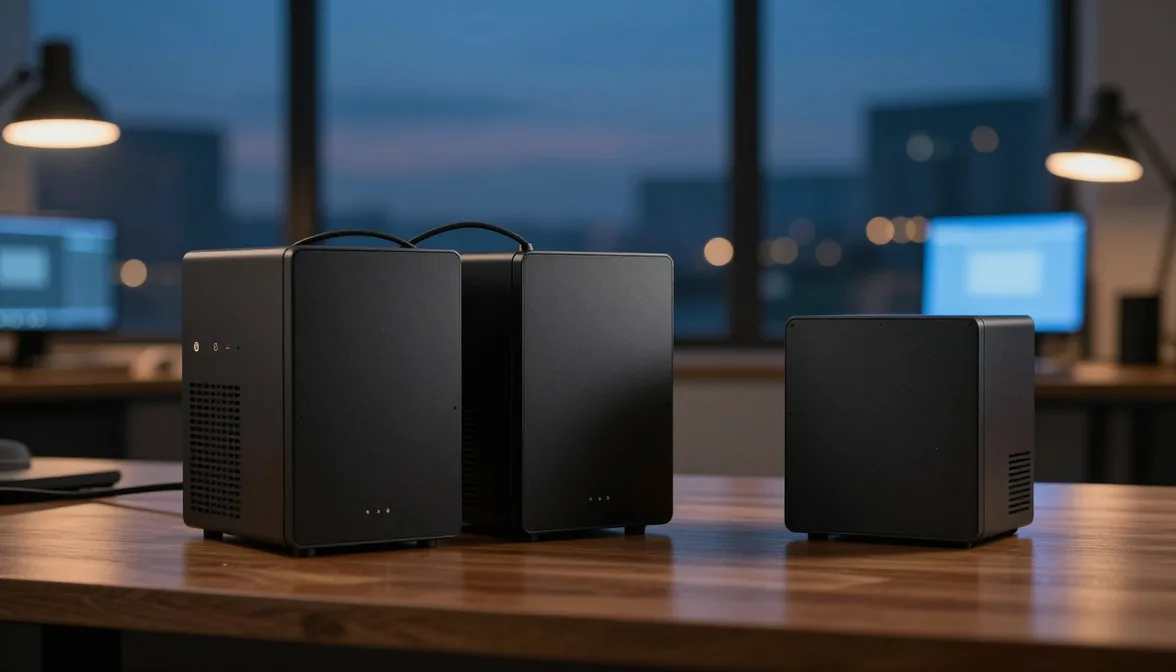
Two computers joined into one machine running the language model, the third for images, sound and video.
The setup described above does a fair amount of work for me every day. At night it processes hundreds of pages of documents, during the day it answers questions, writes reports and prepares materials. I don't pay per request, and the electricity the computers use costs me less than the bill for tokens bought through an API would. I don't have the most powerful model in the world at home, and yet most of the things I wanted to automate simply work, and I am happy with the results. I could hardly ask for better confirmation of what I started with: the best model is not needed for a great many tasks.
How I choose a model: tests on my own tasks
I wrote “at the moment” because every so often I check what is new on the market and test whether one of the new models handles my tasks better than the one I am currently using. I don't go by rankings or by tests published by someone else, because those can have little to do with how a model will handle my particular task. The fact that somewhere it is described as great at reading PDF files doesn't mean it will cope with my PDF files, with their peculiar layout, unusual template and exceptionally complicated naming. So I test on my own tasks, and if a new candidate comes out better, because it is faster, more accurate or needs fewer resources, I swap it in.
I mention this because a few times I have come across the view that a deployment is something you do once and then don't touch. The model you choose today may after a while have a successor that does the same thing faster, more accurately or at lower cost. Then it is worth going through the tests again and judging whether the swap pays off. It will not always pay off, but checking what has changed in the meantime is something I consider part of maintaining such a system, not a separate project.
When a local model is not enough
I don't mean to say that a smaller model can solve every problem. There is a whole class of tasks that local models cannot handle in my setup, and I don't think that will change soon: very complex problems, tasks that require long and precise reasoning, situations in which the model has to take in a huge amount of information at once. For such things a model like Claude Opus 5, Claude Fable 5.1 or one of the latest GPT models will do much better, and I use those models for such purposes myself: my main everyday tool is Claude Code, on a subscription (it is simply the tool that suits me best; a personal preference, not a recommendation), whereas for simpler, repetitive tasks and for many automations a local, smaller model (like GLM 5.3 Flash) is plenty for me. I don't need an expensive, large model to read the data off an invoice or the nutrition facts off a product's packaging.
The data does not leave the company
Local models have one more advantage, which I will only mention, because I think the subject deserves a note of its own: the data does not leave the company. A model running in the cloud (whatever the provider's contracts and statements say) requires sending the data somewhere else, often outside the European Union, where the rules for protecting it may differ from the EU's. A local model can be set up so that all processing happens on the internal network, without sending anything to the internet. In industries such as medicine, law or accounting this can be a more important argument than cost.
The model is not everything
If you are thinking of bringing AI into your company (or more precisely: automation based on AI), you need to know that although the choice of model matters a lot, because there are better and worse models, the model alone does not decide whether the whole thing succeeds. A great deal also depends on how the process around it is organized: how the instructions it receives are phrased, what data it has at its disposal and whether that data is organized, whether there is a lot of it or a little, whether the answers are checked in any way (by another model, by ordinary code, by a person at the end of the process) and how costly a mistake can be, because that determines how much checking you need in the first place. All of this adds up to the result, and in my experience, when these elements are in place, a smaller model is enough far more often than most people assume.
In short
- The most powerful models need hardware, power and conditions that are out of reach for most companies. That is why people use them over the internet and pay for each request.
- Many tasks that companies want to automate are simple and repetitive. In my experience smaller models handle them decently, and they can be run on far more attainable hardware.
- A local model gives full control over the data, because nothing has to leave the company network.
- The model is not everything: it also matters how the instructions are phrased, whether the answers are checked and what a mistake can cost.